The Hidden Cost of Disconnected Marketing: Where Small Businesses Lose Leads (and How to Fix It)
How to loose leads with disconnected marketing.
You've invested in a new website. You're running Google or Meta ads. You've experimented with AI to create content, and maybe you've even set up a CRM and a few automated emails.
So why does your marketing still feel like a collection of disconnected activities rather than a system that's actually helping your business grow?
After more than 30 years working in marketing, I've come to recognize a recurring problem with small businesses. It's not necessarily that they're doing the wrong things. Often, they're doing many of the right things, but those activities aren't connected in a way that consistently moves potential customers from initial interest to an actual sale.
And that's where opportunities get lost.
The problem isn't always a lack of leads, a weak advertising campaign, or an outdated website. Sometimes, the problem is what happens between those activities.
What Is Disconnected Marketing?
Disconnected marketing happens when a business's marketing channels, technology, customer information, and follow-up processes operate independently instead of working together toward a common goal.
For example, your website generates inquiries, but those inquiries aren't automatically recorded in your CRM. Your email marketing platform contains hundreds of contacts, but nobody knows which ones are active prospects. Your advertising generates clicks, but you can't connect those clicks to actual customers.
Each tool may be doing its assigned job perfectly well.
The problem is that nobody has connected the pieces.
A small business marketing system brings these activities together so that prospects can move through a coordinated journey—from discovering your business to becoming customers—while giving you the information needed to improve results.
That doesn't necessarily require expensive software or complicated technology. It requires a thoughtful strategy, clearly defined processes, and the right connections between the tools you're already using.
The Expensive Gap Between a Click and a Customer
Let's imagine a small professional services business investing $2,000 a month in digital advertising.
The campaign generates traffic, and 40 visitors complete a contact form requesting more information.
On the surface, the campaign appears successful. The advertising platform reports conversions, the website is generating inquiries, and the owner is pleased that the phone is ringing.
But let's look a little closer.
Some inquiries are forwarded to an employee's email inbox. Others go into the CRM. A few arrive over the weekend and aren't answered until Monday. Nobody has a consistent follow-up process, and there's no reliable way to identify which inquiries eventually become paying customers.
Suppose 10 of those 40 inquiries never receive a meaningful response.
That's a quarter of the opportunities potentially wasted—not because the advertising failed, but because the process broke down after the lead was generated.
This is a hypothetical example, but it illustrates a common marketing challenge.
And it's not just a small-business issue.
Salesforce's 2026 State of Marketing research found that 69% of surveyed marketers struggle to respond promptly to customers. Disconnected data and limited access to customer information are significant barriers.
The lesson is straightforward: generating more leads doesn't necessarily solve a problem caused by losing the leads you already have.
Before increasing your advertising budget, it may be worth examining what happens after someone expresses interest.
AI Has Made Marketing Easier to Produce, but Not Necessarily Easier to Manage
There's no question that AI has given small businesses access to capabilities that were once expensive or time-consuming.
You can use ChatGPT to develop campaign ideas, generate content outlines, draft emails, analyze customer information, or help create a marketing plan. AI-powered platforms can assist with advertising, website development, CRM workflows, and reporting.
I'm a big believer in using these tools. I use them regularly.
But there's an important distinction between using AI to complete individual marketing tasks and using AI as part of a coordinated marketing strategy.
You can produce ten excellent blog posts, five advertising campaigns, and a month's worth of social media content. But if those activities aren't aligned with your audience, customer journey, business goals, and follow-up process, you're simply producing more marketing.
And more marketing isn't automatically better marketing.
The real opportunity with AI is to make an already thoughtful system more efficient, responsive, and measurable.
AI can help accelerate the work. It shouldn't be expected to create the underlying business strategy on its own.
Six Places Where Your Marketing System May Be Breaking Down
When evaluating a small business's marketing, I like to look at six interconnected stages. Together, they form what I call the Bryt Idea Marketing System. The framework is simple: Attract, Convert, Capture, Nurture, Measure, and Optimize.
Each stage has a specific purpose, but the real value comes from how they work together.
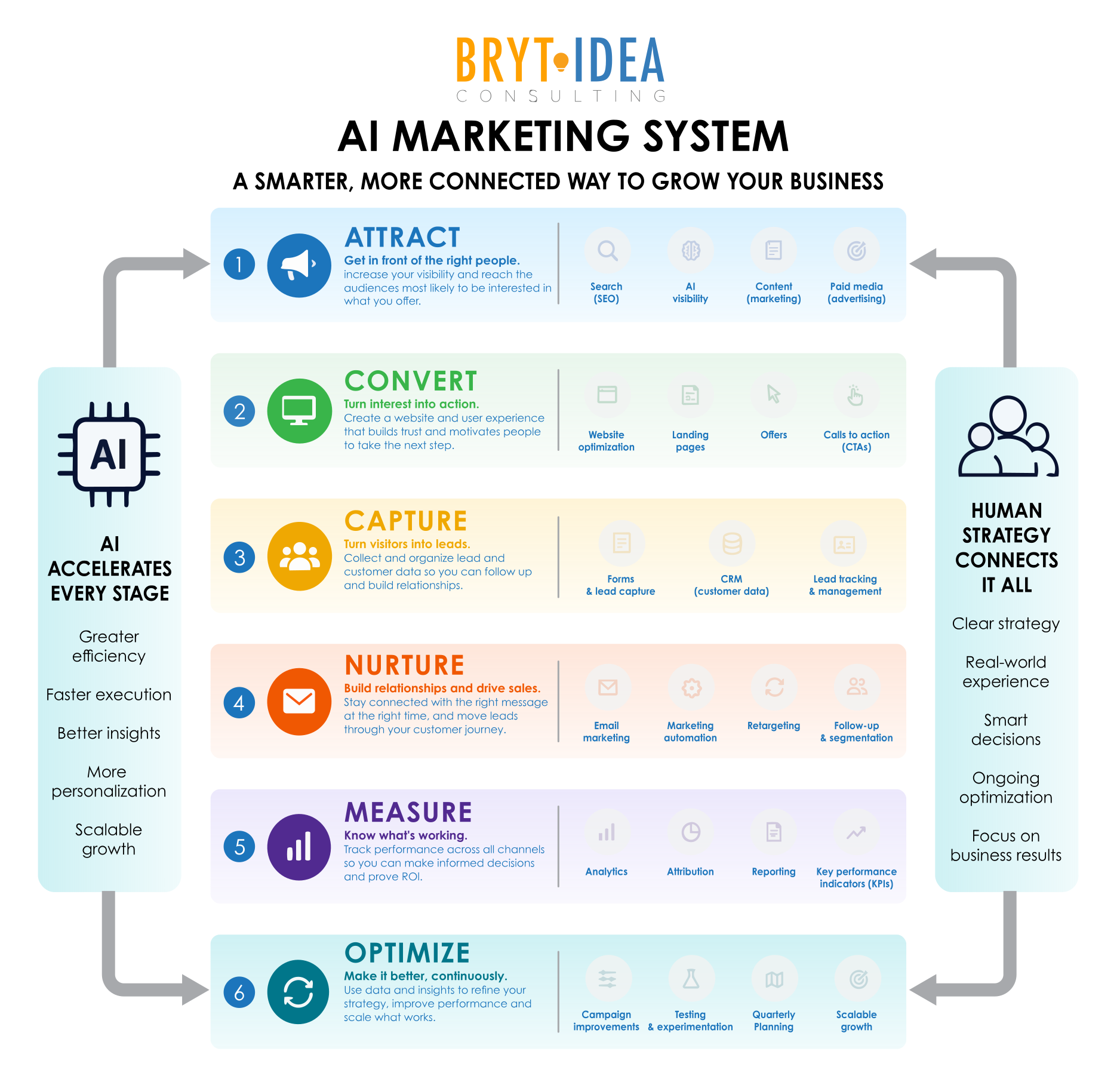
1. ATTRACT: Are You Reaching the Right People?
Your marketing begins with visibility.
Search engine optimization, AI search visibility, social media, content marketing, and paid advertising all help potential customers discover your business.
But attracting more visitors isn't necessarily the objective. Attracting the right visitors is.
If your website receives thousands of visits from people who have no intention of purchasing your services, that traffic may look impressive in an analytics report without producing much business value.
A disconnected approach measures individual channels in isolation. An integrated approach asks which channels are attracting qualified prospects and how those prospects move through the rest of the customer journey.
With AI-powered search experiences becoming more prominent, businesses also need to consider how customers discover and evaluate them before ever visiting their website.
Google's guidance for generative AI search reinforces the importance of useful, original content and established SEO fundamentals.
Visibility still matters. But what happens after someone discovers you matters just as much.
2. CONVERT: Does Your Website Make the Next Step Obvious?
Once someone reaches your website, what do you want them to do?
Schedule a consultation? Request a quote? Download a guide? Register for an event?
Your website needs to make that next step clear.
A common problem I see is businesses investing heavily in getting people to their website while paying relatively little attention to the experience those visitors encounter.
Confusing navigation, vague messaging, weak calls to action, and complicated forms can all discourage potential customers.
A website should do more than describe your services. It should help visitors understand why you're relevant to their needs and make it easy to take the next step.
That doesn't mean every visitor should be pushed into a sales conversation. Some are ready to buy. Others are still researching.
Good website design recognizes those differences and provides appropriate opportunities for engagement.
3. CAPTURE: Where Does the Lead Information Go?
This is where disconnected marketing becomes particularly costly.
Someone completes a form. What happens next?
Does the information automatically enter your CRM? Is the inquiry assigned to the right person? Do you know which page or campaign generated it?
Or does it simply arrive in someone's email inbox?
A CRM doesn't need to be complicated, but it should serve as a reliable place to organize prospects, track interactions, and manage opportunities.
Without a consistent lead-capture process, businesses often end up with contact information scattered across spreadsheets, email accounts, form submissions, and multiple marketing platforms.
That makes it difficult to follow up consistently or understand the complete customer relationship.
A connected system ensures that an inquiry doesn't become an isolated event. It becomes the beginning of a trackable relationship.
4. NURTURE: What Happens When Someone Isn't Ready to Buy?
Not every prospect is ready to make a decision immediately.
Some need additional information. Others are comparing options, waiting for budget approval, or simply exploring possibilities.
This is where thoughtful lead nurturing becomes valuable.
Email marketing, CRM workflows, personalized follow-up, and retargeting can help maintain relationships without requiring someone to manually manage every interaction.
For example, a prospect who downloads a guide about improving their marketing could receive a short series of useful follow-up emails. One might explain a common challenge, another could provide a practical recommendation, and a third might invite a conversation.
The key is relevance.
Automation should support a relationship, not turn every inquiry into an endless stream of generic sales messages.
And when someone replies or expresses genuine interest, there should be a clear process for human follow-up.
5. MEASURE: Do You Know What's Actually Working?
One of the most frustrating situations for a business owner is spending money on marketing without understanding what it's producing.
Google Analytics may show traffic. Your advertising platform reports clicks and conversions. Your email platform provides open and click rates.
But how many qualified leads did you generate? How many became customers? Which marketing activities contributed to those results?
Those questions require information from different systems to be connected.
You don't necessarily need sophisticated attribution software. For many small businesses, a properly configured CRM, consistent campaign tracking, and a straightforward monthly report can provide a much clearer picture.
I generally prefer a handful of meaningful business metrics over an elaborate dashboard full of numbers nobody uses.
If you know where leads originate, how effectively they're followed up, and how many become customers, you're already in a much stronger position to make informed decisions.
6. OPTIMIZE: Are You Learning From the Results?
Marketing shouldn't operate on autopilot indefinitely.
What worked six months ago may not be the best approach today.
Customer behavior changes. Competitors adjust their strategies. Search platforms evolve. Advertising costs fluctuate. New AI capabilities emerge.
An integrated marketing system gives you the information needed to respond.
Perhaps your website attracts plenty of qualified visitors but converts poorly. That suggests a website or offer problem.
Maybe inquiries are strong, but few turn into sales conversations. That could indicate a follow-up issue.
Or perhaps one advertising campaign consistently produces higher-quality customers than another.
When you can see the complete picture, you can focus your time and budget on improving the parts of the system that matter most.
That's what ongoing optimization should accomplish.
How to Find the Gaps in Your Own Marketing
You don't need to purchase another platform to begin identifying where your marketing is disconnected.
Start by following the journey of one hypothetical customer.
Imagine someone searches Google for a service you offer, visits your website, and submits an inquiry.
Now ask yourself what actually happens.
How does that person find your business? Is the website messaging relevant to their needs? Does the inquiry reach the right person? Is it recorded in your CRM? How quickly does someone respond? What happens if the prospect doesn't reply? Can you determine whether that inquiry eventually becomes a customer?
Walk through the process from beginning to end.
Better yet, submit a test inquiry through your own website and observe what happens.
You'll often learn more from that exercise than from reviewing another month's worth of website traffic reports.
Pay particular attention to the handoffs between systems and people. That's where information gets lost, responsibilities become unclear, and opportunities can quietly disappear.
Build a Better System Before Buying More Tools
When businesses recognize these problems, their first instinct is sometimes to look for new software.
A better CRM. Another AI platform. A more sophisticated automation system. A different email marketing service.
Sometimes new technology really is necessary.
But often, the better starting point is to make the existing technology work properly.
Choose a primary CRM where customer information belongs. Make sure website forms connect to it. Establish a clear process for assigning and following up with leads. Build a few useful automated workflows. Connect your reporting to the business outcomes you actually care about.
And make someone responsible for reviewing the results.
That's the foundation.
Once those basics are working, AI can add considerable value by helping analyze information, personalize appropriate communications, identify patterns, and reduce repetitive administrative work.
But the sequence matters.
Strategy first. Integration second. Automation third. Ongoing optimization always.
What Does an Integrated Small Business Marketing System Actually Look Like?
An integrated marketing system doesn't have to be elaborate.
For a small service business, it might consist of a well-optimized website, a CRM, an email marketing platform, Google Analytics, a few carefully selected advertising channels, and a consistent monthly reporting process.
The important part isn't how many tools you have.
It's whether the tools share the information needed to support the customer journey, whether your team knows what to do with that information, and whether you can measure the results.
Ideally, a prospect should be able to discover your business, understand your offer, make an inquiry, receive timely follow-up, and move toward becoming a customer without information getting lost along the way.
That's what I mean by a connected marketing system.
And it can be built gradually, starting with the biggest gaps rather than trying to overhaul everything at once.
The Real Competitive Advantage Is Making Everything Work Together
AI is changing how businesses create and execute marketing. That's not going away.
But as these tools become increasingly accessible, simply having them won't be much of a competitive advantage.
The advantage comes from knowing what you're trying to accomplish, understanding your customers, connecting your marketing activities, and continuously improving based on real results.
After three decades in marketing, I'm convinced that the fundamentals still matter. Clear positioning, a compelling offer, a good customer experience, consistent follow-up, and measurable outcomes are just as important today as they've ever been.
AI can help us execute those fundamentals faster and more efficiently.
But it doesn't eliminate the need for them.
If your website, SEO, advertising, CRM, email, and AI tools are operating independently, you may have more opportunity sitting inside your existing marketing than you realize.
At Bryt Idea Consulting, I've developed the Small Business Marketing Accelerator to help businesses identify those gaps, connect the essential pieces, and create a more coordinated approach to marketing.
It's not about adding more tools or producing more content.
It's about making the marketing you're already doing work better—and building a system you can continue to improve over time.